A Matter of Fact - Harper's BAZAAR March 2022
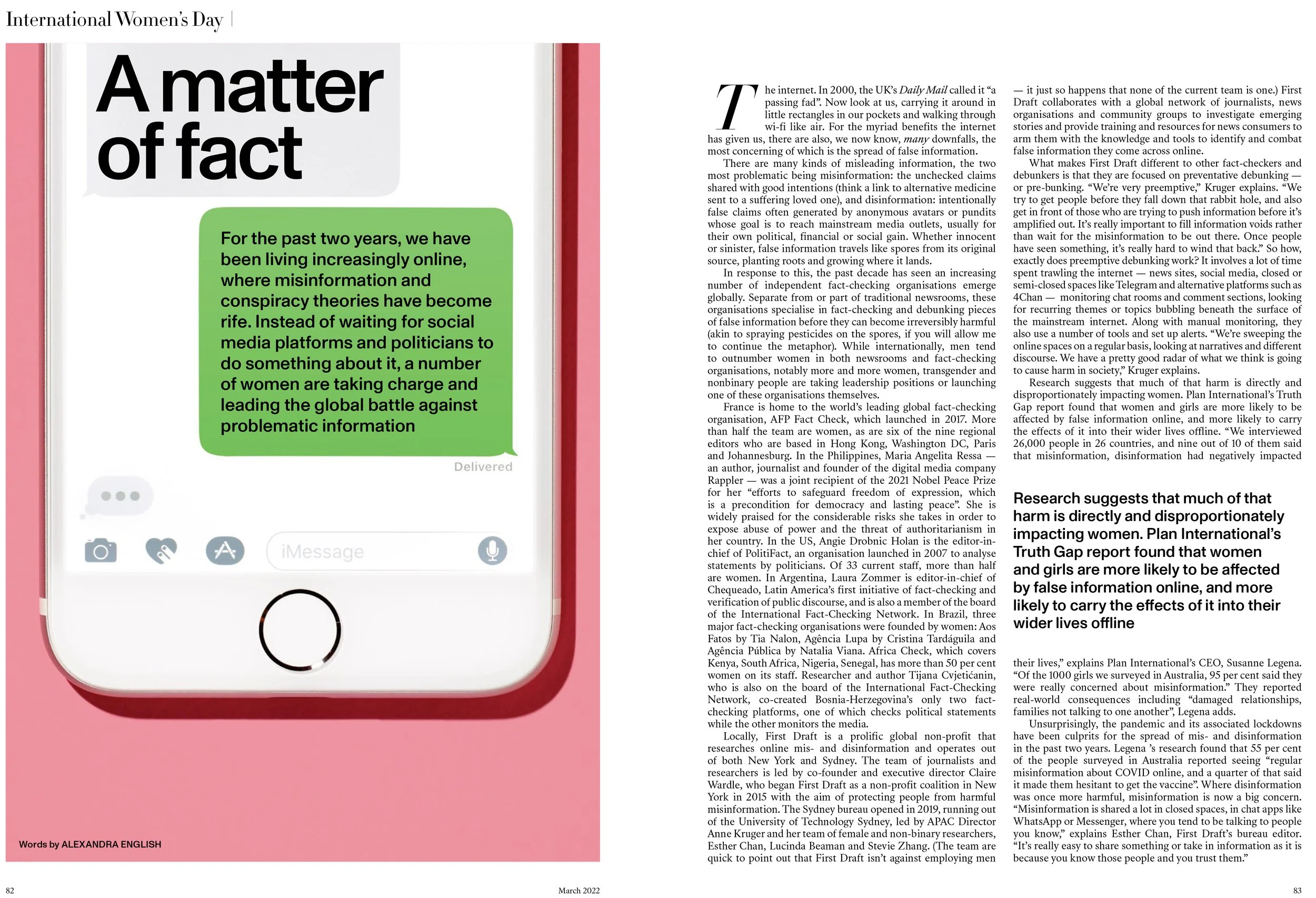
For the past two years, we have been living increasingly online, where misinformation and conspiracy theories have become rife. Instead of waiting for social media platforms and politicians to do something about it, a number of women are taking charge and leading the global battle against problematic information
The internet. In 2000, the UK’s Daily Mail called it “a passing fad”. Now look at us, carrying it around in little rectangles in our pockets and walking through wi-fi like air. For the myriad benefits the internet has given us, there are also, we now know, many downfalls, the most concerning of which is the spread of false information.
There are many kinds of misleading information, the two most problematic being misinformation: the unchecked claims shared with good intentions (think a link to alternative medicine sent to a suffering loved one), and disinformation: intentionally false claims often generated by anonymous avatars or pundits whose goal is to reach mainstream media outlets, usually for their own political, financial or social gain. Whether innocent or sinister, false information travels like spores from its original source, planting roots and growing where it lands.
In response to this, the past decade has seen an increasing number of independent fact-checking organisations emerge globally. Separate from or part of traditional newsrooms, these organisations specialise in fact-checking and debunking pieces of false information before they can become irreversibly harmful (akin to spraying pesticides on the spores, if you will allow me to continue the metaphor). While internationally, men tend to outnumber women in both newsrooms and fact-checking organisations, notably more and more women, transgender and nonbinary people are taking leadership positions or launching one of these organisations themselves.
France is home to the world’s leading global fact-checking organisation, AFP Fact Check, which launched in 2017. More than half the team are women, as are six of the nine regional editors who are based in Hong Kong, Washington DC, Paris and Johannesburg. In the Philippines, Maria Angelita Ressa — an author, journalist and founder of the digital media company Rappler — was a joint recipient of the 2021 Nobel Peace Prize for her “efforts to safeguard freedom of expression, which is a precondition for democracy and lasting peace”. She is widely praised for the considerable risks she takes in order to expose abuse of power and the threat of authoritarianism in her country. In the US, Angie Drobnic Holan is the editor-in-chief of PolitiFact, an organisation launched in 2007 to analyse statements by politicians. Of 33 current staff, more than half are women. In Argentina, Laura Zommer is editor-in-chief of Chequeado, Latin America’s first initiative of fact-checking and verification of public discourse, and is also a member of the board of the International Fact-Checking Network. In Brazil, three major fact-checking organisations were founded by women: Aos Fatos by Tia Nalon, Agência Lupa by Cristina Tardáguila and Agência Pública by Natalia Viana. Africa Check, which covers Kenya, South Africa, Nigeria, Senegal, has more than 50 per cent women on its staff. Researcher and author Tijana Cvjetićanin, who is also on the board of the International Fact-Checking Network, co-created Bosnia-Herzegovina’s only two fact-checking platforms, one of which checks political statements while the other monitors the media.
Locally, First Draft is a prolific global non-profit that researches online mis- and disinformation and operates out of both New York and Sydney. The team of journalists and researchers is led by co-founder and executive director Claire Wardle, who began First Draft as a non-profit coalition in New York in 2015 with the aim of protecting people from harmful misinformation. The Sydney bureau opened in 2019, running out of the University of Technology Sydney, led by APAC Director Anne Kruger and her team of female and non-binary researchers, Esther Chan, Lucinda Beaman and Stevie Zhang. (The team are quick to point out that First Draft isn’t against employing men — it just so happens that none of the current team is one.) First Draft collaborates with a global network of journalists, news organisations and community groups to investigate emerging stories and provide training and resources for news consumers to arm them with the knowledge and tools to identify and combat false information they come across online.
What makes First Draft different to other fact-checkers and debunkers is that they are focused on preventative debunking — or pre-bunking. “We’re very preemptive,” Kruger explains. “We try to get people before they fall down that rabbit hole, and also get in front of those who are trying to push information before it’s amplified out. It’s really important to fill information voids rather than wait for the misinformation to be out there. Once people have seen something, it’s really hard to wind that back.” So how, exactly does preemptive debunking work? It involves a lot of time spent trawling the internet — news sites, social media, closed or semi-closed spaces like Telegram and alternative platforms such as 4Chan — monitoring chat rooms and comment sections, looking for recurring themes or topics bubbling beneath the surface of the mainstream internet. Along with manual monitoring, they also use a number of tools and set up alerts. “We’re sweeping the online spaces on a regular basis, looking at narratives and different discourse. We have a pretty good radar of what we think is going to cause harm in society,” Kruger explains.
Research suggests that much of that harm is directly and disproportionately impacting women. Plan International’s Truth Gap report found that women and girls are more likely to be affected by false information online, and more likely to carry the effects of it into their wider lives offline. “We interviewed 26,000 people in 26 countries, and nine out of 10 of them said that misinformation, disinformation had negatively impacted their lives,” explains Plan International’s CEO, Susanne Legena. “Of the 1000 girls we surveyed in Australia, 95 per cent said they were really concerned about misinformation.” They reported real-world consequences including “damaged relationships, families not talking to one another”, Legena adds.
Unsurprisingly, the pandemic and its associated lockdowns have been culprits for the spread of mis- and disinformation in the past two years. Legena ’s research found that 55 per cent of the people surveyed in Australia reported seeing “regular misinformation about COVID online, and a quarter of that said it made them hesitant to get the vaccine”. Where disinformation was once more harmful, misinformation is now a big concern. “Misinformation is shared a lot in closed spaces, in chat apps like WhatsApp or Messenger, where you tend to be talking to people you know,” explains Esther Chan, First Draft’s bureau editor. “It’s really easy to share something or take in information as it is because you know those people and you trust them.”
“Everyone’s been disconnected in real life, so they’ve turned to social media for their information,” adds Stevie Zhang, First Draft’s APAC associate editor. “Normally, they would talk to a friend and have their concerns addressed, but instead they’re looking online where there are all these information voids.” Legena has seen the same. “If you’re going to work or school or you’re hanging out with your friends, you’ve got this more diverse group of diverse perspectives that are challenging you to triangulate information. You might say, ‘Oh, I saw this thing online,’ and someone else might go, ‘I don’t think that’s right.’ But when all of our lives moved online, we became more dependent on that source of information, and it was having devastating effects.”
Without satisfactory information, there’s potential for people to fall into rabbit holes that lead to alternative platforms and apps, such as Telegram or 4Chan, which are rife with disinformation and conspiracy theories. This is where, Kruger says, the meeting between “those who are driving [false information] because they get something out of it, and those who are getting into it because they are genuinely scared” can be devastating. “People truly believe these things, and they don’t necessarily know who started this or who’s behind it,” she says. “Some people are genuinely sharing things because they’re scared or trying to protect their families, and then there are the agents of disinformation who are often getting financial gain from it.”
Once an issue has been identified — at the moment, First Draft is concerned about COVID, climate change and the upcoming federal election — the next step is to inform their network of journalists, many of whom work for The Guardian, the ABC and regional mastheads and broadcast networks. “We make sure the media can cover things in a way that helps make news consumers a bit more resilient to misinformation and disinformation,” says Zhang, who recently researched and gave editorial advice on the COVID-19 lab leak theory. As for politics, that’s where the CrossCheck Election Watch program comes in. First Draft ran a training course for more than 100 journalists, demonstrating how to responsibly determine what deserves coverage and what shouldn’t be given oxygen. Chan gives the example of political narratives that have carried over from the US. “There have already been claims that there will be voter fraud [in the federal election this year]. It’s just an interesting phenomenon, where we see Australians copying what’s happening in the US,” she explains. Lucinda Beaman, First Draft’s senior researcher, also cites politicians who have spread misinformation from their public platforms. “Some politicians go rogue, but they’re still part of a party. The standard you walk past is the standard you accept, so we also need to be putting pressure back on politicians to hold each other accountable.”
Through CrossCheck, journalists are encouraged to share information and work together to limit the spread of harmful narratives. “It does require a massive rethink,” Beaman adds, “because [media] organisations are competitive, and it’s a different mindset to have this collaborative approach. It has worked overseas, and that’s what we’re building here, but everyone needs to get involved: it’s too big a problem for this to be worked on in silos, so that does require a bit of a change in mindset that’s going to have to come.”
Educating journalists and news consumers is just one part of the fight against mis- and disinformation. To truly have an impact, Legena says, there needs to be digital literacy on the school curriculum (in Finland, kids start learning how to check sources as early as kindergarten), legislation around the proliferation of false information, and more responsibility taken by the social media platforms.
“Everyone needs to work together,” says Kruger. “There’s been a lot of good work so far, but we’re really only at the start. And we’re never going to be finished.”
This article originally appeared in the March 2022 issue of Harper’s BAZAAR. Getty images.